
CONFOTUR 2026: What Taxes You Save When Buying in Punta Cana and How to Verify if a Project is Approved
The luxury real estate market in Punta Cana and Cap Cana has established itself as the epicenter of wealth investment in the Caribbean. For sophisticated investors, cutting-edge architecture, scarcity of beachfront land, and championship golf courses are undeniable drivers of capital appreciation. However, the most aggressive financial catalyst that transforms a standard real estate investment into a high-yield asset is not scenic, but fiscal: the Tourism Development Incentive Law, universally known as the CONFOTUR 2026 Law.
Despite being the most powerful tax benefit in the region, its governing legal framework is frequently misunderstood. Not all projects in the Dominican Republic enjoy these exemptions, and a mistake during the due diligence phase can cost tens of thousands of dollars in lost cash flow.
In this thorough technical breakdown, we analyze with surgical precision exactly which taxes an investor saves when buying under this law and the precise commercial steps to verify a project’s legitimacy.
Featured Investment Opportunity in Punta Cana: Sun Garden Apartments
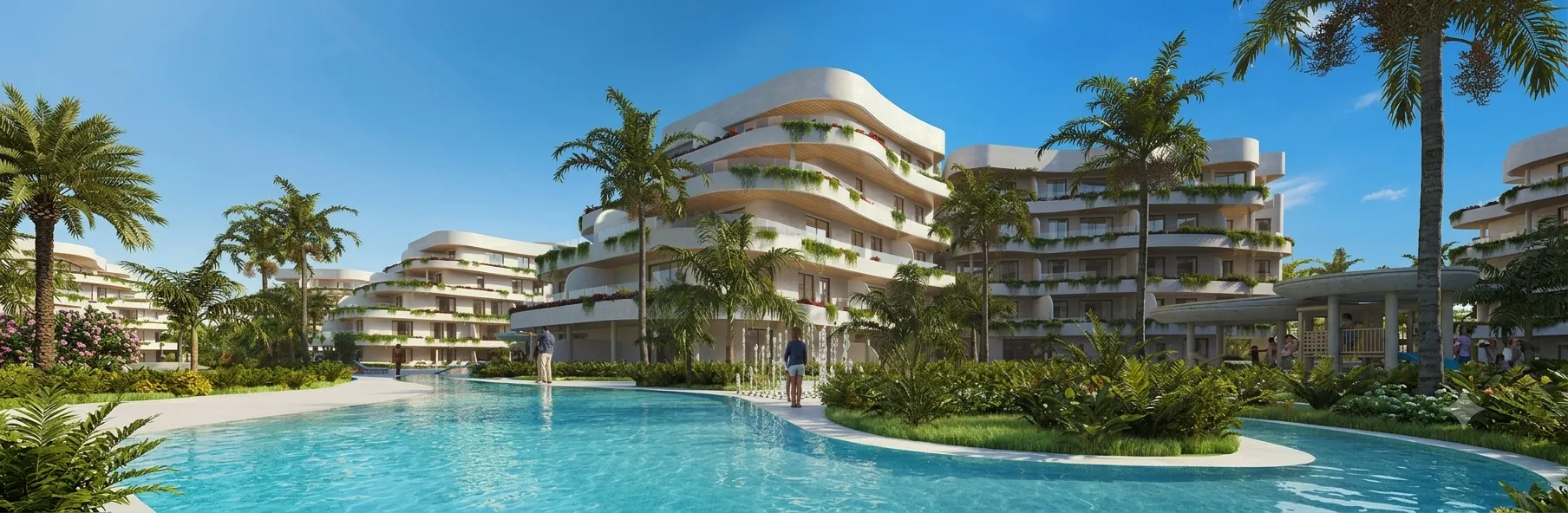
- For investors looking to qualify for residency while building a profitable real estate portfolio, Sun Garden offers a prime opportunity in Punta Cana:
- 1-Bedroom Apartments: Ranging from 45 m² to 56 m² (484 to 602 sq ft), ideal for short-term vacation rentals or couples. Starting from $157,500 USD.
- 2-Bedroom Apartments: Spacious layouts between 88 m² and 146 m² (947 to 1,571 sq ft), perfect for small families or extended seasonal stays. Starting from $271,000 USD (Qualifies directly for Investor Residency).
- 3-Bedroom Apartments & Penthouses: Exclusive residences spanning from 111 m² to 188 m² (1,194 to 2,023 sq ft). Prices range from $340,000 USD to $535,600 USD for top-tier penthouse units (Qualifies directly for Investor Residency).
What is the CONFOTUR 2026 Law and Why Does It Redefine Your ROI?
Originally enacted as Law No. 158-01, and later amended and expanded by Law No. 195-13, CONFOTUR 2026 is a tax incentive framework created by the Dominican state. Its strategic objective is to hyper-accelerate tourism infrastructure development in selected hubs, attracting institutional capital and high-net-worth international private investors (HNWIs).
For a real estate investor, operating within a CONFOTUR-protected ecosystem radically alters the Return on Investment (ROI) equation. By eliminating the structural tax costs associated with acquiring and holding real estate, capital that would normally be consumed by government fees is directly retained in the owner’s net cash flow.
The Tax Architecture: Which Taxes Do You Save Exactly When Buying in Punta Cana?
When acquiring a premium residential property or a vacation condo optimized for short-term rental platforms under CONFOTUR, you are exempted from the two heaviest tax burdens in the Dominican tax system:
- Exemption from Real Estate Transfer Tax (3%) In a standard real estate transaction in the Dominican Republic, the buyer must pay a one-time government tax of 3% on the property’s tax value to register the real estate in their name and issue the new Title Certificate.
- Financial Impact: If you purchase a pre-construction luxury villa or high-end condo valued at $400,000 USD, a standard transaction would require an immediate, non-recoverable out-of-pocket expense of $12,000 USD just for the title transfer. Under CONFOTUR 2026, this cost is reduced to zero. Capital savings are captured from day one of closing.
- Exemption from Real Estate Property Tax (IPI – 1%) The Real Estate Property Tax (IPI) is the annual property tax levied on real estate held by individuals. Currently, a 1% rate applies to the value exceeding the total property threshold assessed by the Internal Revenue Directorate (DGII).
- Financial Impact: CONFOTUR 2026 grants a 100% total exemption from this annual tax for up to 15 years. Following the example of a property valued at $400,000 USD, annualized savings are approximately $4,000 USD. Over the 15-year benefit period, the investor retains roughly $60,000 USD that would otherwise erode rental yields.
- Exemption from Income Tax (ISR) on Rental Income If the development’s structure includes hotel management or a rental pool operated under the law’s scope, profits generated from tourism rental operations can benefit from substantial income tax exemptions, optimizing commercial net returns.
Direct Impact Summary on Your Profitability ($400,000 USD Asset):
- Immediate Closing Savings: $12,000 USD retained by eliminating the 3% transfer tax.
- Accumulated Holding Savings: ~$60,000 USD protected by avoiding the 1% annual IPI over 15 years.
- Total Capital Retention: A direct positive impact of ~$72,000 USD, yielding an aggressive maximization of annual net ROI compared to a standard purchase.
Technical Verification Guide: How to Verify if a Project is Legitimately CONFOTUR 2026-Approved
The popularity of CONFOTUR has led some developers to use the term loosely as a marketing tactic during pre-sale phases, claiming the project is “in the process of approval.” For an international investor, ambiguity presents an unacceptable risk.
To execute rigorous due diligence, follow these three legal validation steps:
- Step 1: Request the Official MITUR and CESTUR Resolution CONFOTUR 2026 approval is neither verbal nor automatic; it is granted via a strict institutional technical document. You must request a copy of the Definitive Resolution issued by the Tourism Development Council (CONFOTUR), an entity under the Ministry of Tourism (MITUR), from the developer or your trusted real estate broker.
- What to look for: The document must state the developer’s exact corporate name, the technical project name, and specify Definitive Approval. Provisional approvals indicate the project is still under evaluation, and tax benefits are not legally consolidated for end buyers.
- Step 2: Verify the Registration Code and Status with the DGII Once MITUR issues the resolution, the project must be registered with the Internal Revenue Directorate (DGII) so automated exemptions apply in tax control systems. The developer must supply the official certification linking individual property title numbers (matrículas) to the CONFOTUR regime.
- Step 3: Consult the Public Database of the Ministry of Tourism The Ministry of Tourism of the Dominican Republic maintains an updated registry of tourism companies and projects holding official classification. A qualified local real estate attorney can cross-reference the resolution number directly in Council records to ensure there are no zoning disputes or density issues compromising the land classification.
Mitigating Risks: The Role of the Broker in High-Yield Asset Acquisition
The Caribbean real estate market rewards sophistication and penalizes improvisation. Buying off-plan in high-growth areas like Cap Cana, Cana Bay, or premium Punta Cana developments offers the most competitive prices per square meter, but requires impeccable documentary verification.
An advisor with true technical expertise in the Dominican market goes beyond presenting renders or ROI projections. Their core value lies in auditing the project’s legal structure: confirming that escrow structures are set up with regulated banks, validating that environmental permits satisfy local regulations, and certifying that CONFOTUR exemptions are properly deeded.
By safeguarding your acquisition through rigorous tax documentation analysis, you ensure that net short-term rental yields—which consistently range between 8% and 12% annually in these beach and golf destinations—are not eroded by tax inefficiencies. CONFOTUR 2026 is not merely a government incentive; it is the ultimate structural tool to build, expand, and protect your real estate portfolio in the Caribbean.

Living in Cap Cana
What Is It Like Living in Cap Cana? Essential Services & Exclusivity for Residents Punta…

Non-Resident Mortgage in Punta Cana
Can a Non-Resident Get a Mortgage on a Property in Punta Cana? (2026 Guide) One…

CONFOTUR 2026
CONFOTUR 2026: What Taxes You Save When Buying in Punta Cana and How to Verify…

Sun Garden Punta Cana | Luxury Condos in Coral Golf
Sun Garden at Coral Golf Resort: Luxury Condos and High-Yield Investment in Punta Cana If…

Buying a Property in Punta Cana with Bitcoin
Buying a Property in Punta Cana with Bitcoin or Cryptocurrencies: Legal and Tax Guide for…

Larimar Smart City & Resort
Larimar City & Resort: How the Caribbean’s First Smart City Redefines Punta Cana Real Estate…